
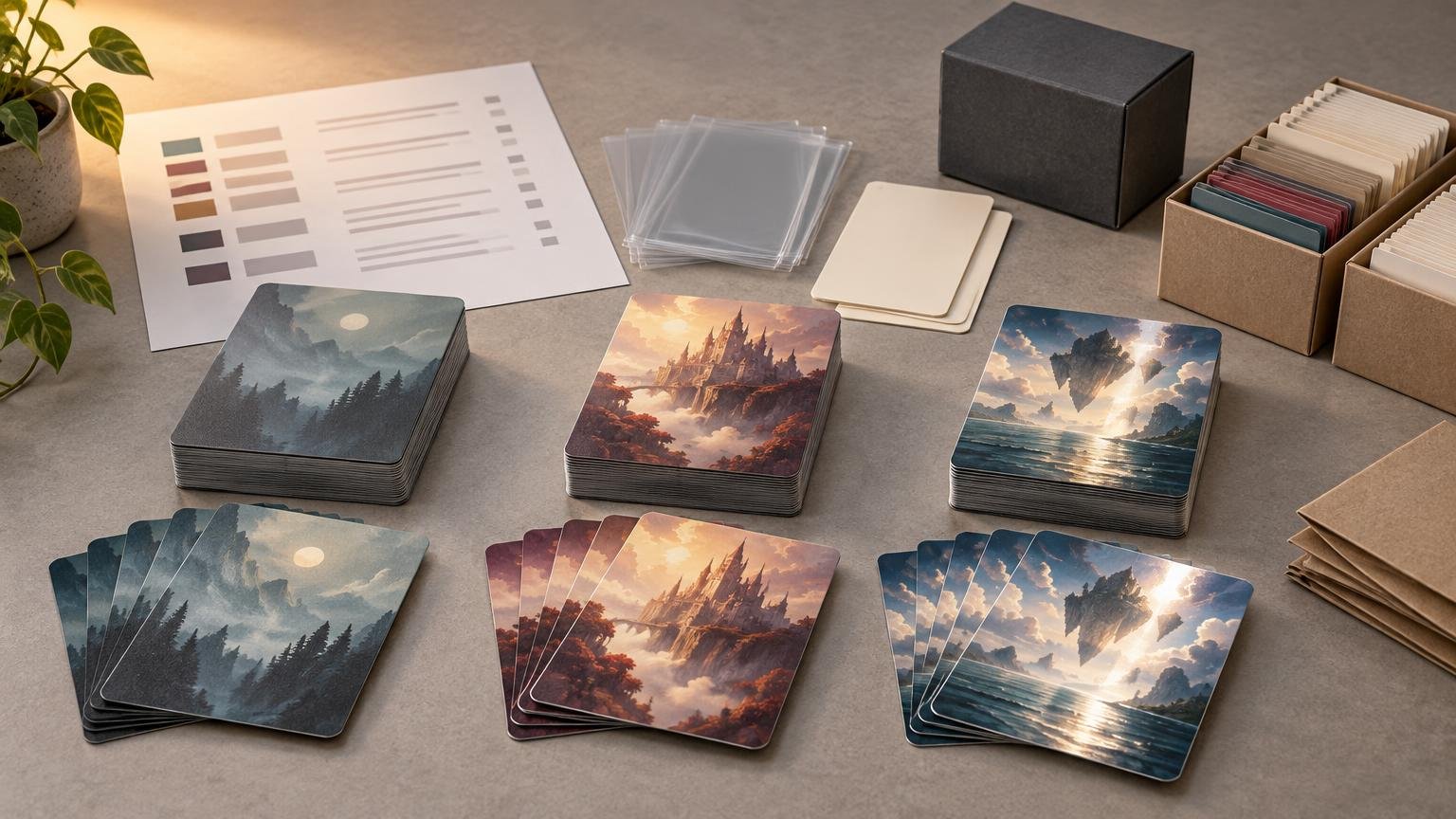
For most MTG proxy decks, satin is the best all-around finish: it keeps reflections under control without making the artwork look completely flat. Matte is the better choice under bright overhead lighting or when fingerprints are a recurring annoyance. Gloss delivers the strongest shine and can make colors look richer, but it also produces the most glare.
That answer changes slightly once the cards go into sleeves. The sleeve exterior becomes the card-to-card contact surface, so the printed finish matters more for appearance than shuffle feel. For an unsleeved Cube, token set, or casual battle box, the coating itself has a much larger effect on handling.
The practical differences at the table
In standard print terminology, matte is a low-sheen surface, satin sits between matte and gloss, and gloss is smooth, shiny, and strongly reflective. The most dependable distinction is optical: matte minimizes glare, satin retains restrained sheen, and gloss creates the strongest reflections. Graphic Design and Print Production Fundamentals provides a useful overview of these conventional finish categories.
| Finish | Glare | Color appearance | Surface feel | Fingerprint visibility | Best fit |
|---|---|---|---|---|---|
| Matte | Lowest | Even and subdued under direct light | Often feels drier or less slick | Usually the least noticeable | Bright rooms, webcam play, text-heavy cards |
| Satin | Low to moderate | Balanced contrast with slight lustre | Usually between matte and gloss | Moderate | General gameplay and mixed lighting |
| Gloss | Highest | Can look richer because of surface reflection | Often feels smoother | Smudges tend to stand out under direct light | Display-focused projects and vivid artwork |
Gloss does not change the underlying printed color values by itself. Its reflective surface can make those colors appear richer or more saturated in favorable light. Turn the card toward a ceiling lamp, however, and the same reflection can obscure rules text or dark artwork.
Matte prioritizes readability and glare control
Matte is the practical choice when cards need to remain readable across a large table. It diffuses reflections instead of sending a bright highlight back toward the player, which helps under ceiling fixtures, near windows, and during webcam games.
Wizards of the Coast says it uses matte finishes on most Magic cards to minimize glare. Its playing-card coating explanation also describes coatings as protective layers that help reduce moisture effects, scuffing, wear, and ink lifting caused by finger oils.
The tradeoff is visual rather than functional. Without a strong reflective sheen, deep blacks and highly saturated artwork may look less dramatic than they do on gloss. That is usually a good exchange for a Commander deck, cEDH practice deck, or Cube that will spend most of its time under ordinary game-store lighting.
Satin is the safest all-purpose compromise
Satin retains a slight lustre while avoiding the mirror-like reflections associated with gloss. That balance works well for a full deck containing dark frames, bright borderless art, dense rules text, and cards from many visual eras.
The catch is that “satin” is not a universal technical specification. Suppliers may use satin, silk, lustre, or semi-gloss for nearby but not identical surfaces. Two products carrying the same finish label can differ in sheen and handling.
Read the product-specific coating description instead of choosing from the finish name alone. When checking a current ordering route such as ProxyFoundry MTG proxies and playtest-card printing, confirm what the listed coating actually describes and use a small validation batch when the exact surface matters.
Gloss favors visual impact over flexible lighting
Gloss is most attractive when the viewing angle and lighting are controlled. It can give colorful spells, showcase frames, and high-contrast artwork a polished appearance. It is less dependable at a multiplayer table, where every player sees the cards from a different angle.
The reflective surface also makes fingerprints and wiping marks easier to notice, especially on dark cards. This does not automatically make gloss unsuitable for play, but it gives the project another variable to test before committing to hundreds of cards.
Finish names do not predict shuffle feel by themselves
It is tempting to reduce the options to matte equals grippy and gloss equals slippery. Real card handling is more complicated. Research into coated-paper friction identifies coating composition, calendering, lubricants, and microscopic surface structure as relevant factors. The finish category alone does not fully predict friction. Research published in the Journal of Wood Science discusses these interacting surface variables.
Wizards describes playing-card coatings as a balance between slip and grip: cards need to slide without sticking together or becoming uncontrollably slippery. A well-executed matte card can therefore slide more cleanly than a poorly executed gloss card, and two satin products can handle differently.
For sleeved proxies, evaluate the complete stack rather than rubbing two bare card faces together. Sleeve texture governs sliding, while card thickness, stiffness, cut consistency, and corner shape still affect how the deck stacks and shuffles. ProxyFoundry also presents this as a practical consideration for sleeved proxy decks, although that explanation is vendor guidance rather than independent testing.
Test the finish as a deck project
A single attractive sample does not prove that a finish will work across a 100-card Commander deck or a 540-card Cube. Test enough cards to reproduce the actual handling and lighting conditions.
- Choose a representative mix: dark artwork, bright artwork, small rules text, borderless frames, and at least one double-faced card if the project includes them.
- Inspect the cards under the lights where the deck will usually be played. Tilt dark cards through several viewing angles and watch for reflections across names, mana costs, and text boxes.
- Handle the cards with clean, dry hands and check how readily fingerprints appear. Wipe one card using the care method you expect to use later and inspect it again under angled light.
- Put the samples in the exact sleeves planned for the finished deck. Build a stack large enough to evaluate deck height, stiffness, sliding, and mash shuffling.
- Compare color and text readability before judging shine. A finish cannot repair a weak source image, so verify that the files meet an appropriate resolution for professionally printed MTG proxies.
- Record the supplier, product option, coating description, order date, and sample result. Those details are more useful for a future reorder than the word “satin” by itself.
Keep one finish across the project
Mixing finishes inside one deck creates a consistency problem. Even in opaque sleeves, different coatings or stocks may produce small differences in stiffness, thickness, edge appearance, or how cards sit in the stack. That is particularly annoying when a ten-card upgrade batch feels unlike the original ninety cards.
Order the complete deck from one defined specification when possible. If a project includes replacements, tokens, sideboards, or extra copies, include them in the original batch or archive enough information to reproduce it later. Finish consistency belongs in the same project record as set codes, collector numbers, quantities, card backs, and special-face pairings.
Proof the artwork separately from the coating decision. Dark borderless cards can expose both glare and trimming problems, so check the project’s bleed and edge-crop risks before approving the batch.
The final choice
Choose matte when glare control and easy reading are the priorities. Choose satin for the most adaptable balance of restrained shine, color presence, and everyday play. Choose gloss when vivid presentation matters more than performance under unpredictable lighting.